Ceramic braces are the discreet version of fixed braces: the same treatment, with brackets that blend in with your teeth.
This guide explains how ceramic braces are bonded to your teeth, how discreet they are, what happens at each appointment, who they are right for, what causes staining, and how they compare with removable clear aligners.
Ceramic Braces: What They Are & How They Straighten Teeth
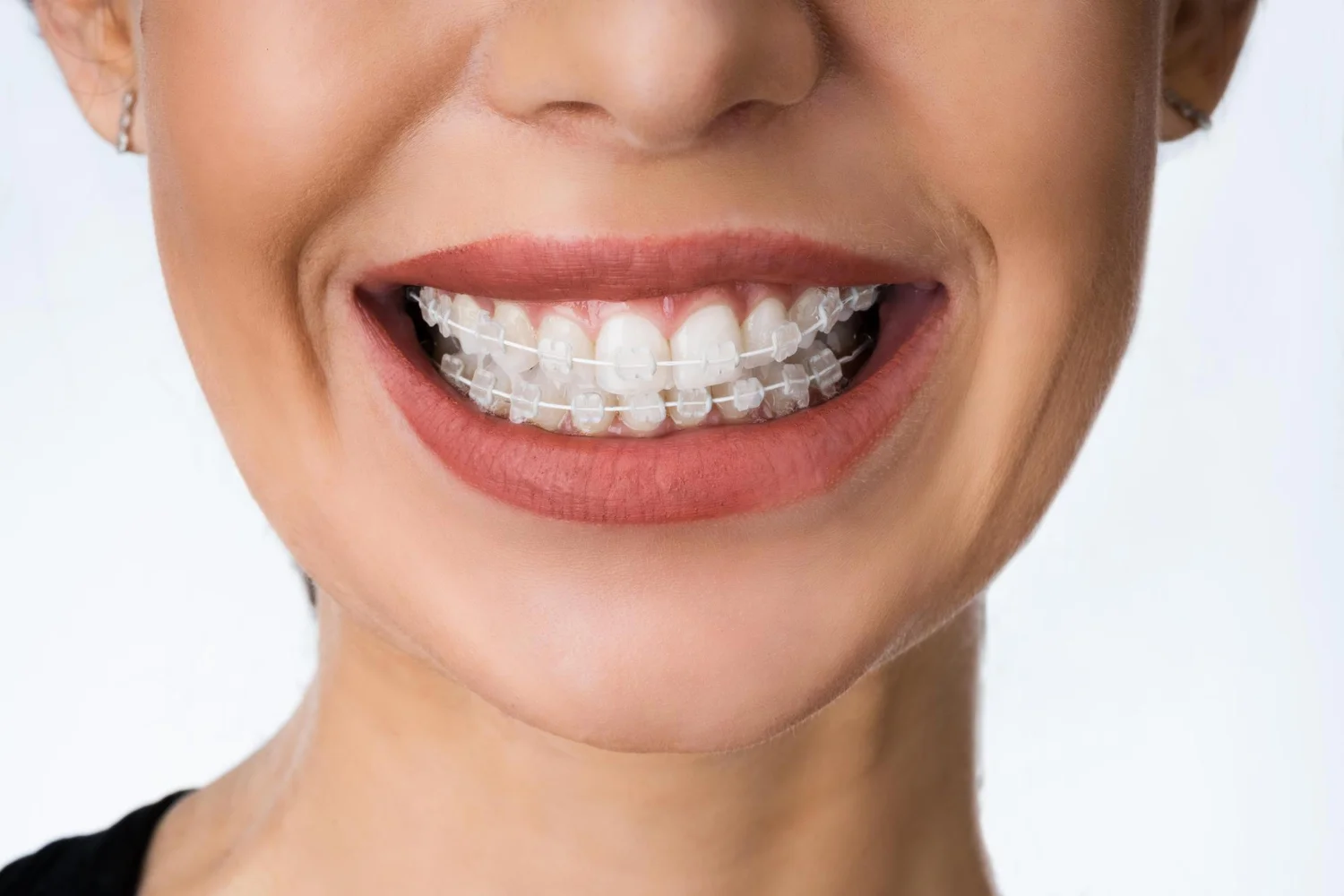
Ceramic braces are fixed braces with clear or tooth-coloured brackets instead of metal ones. They work the same way: brackets bonded to each tooth, and an archwire between them pulling the teeth into line. Only the material changes. The British Orthodontic Society still lists fixed appliances as the most popular type of orthodontic appliance, available in metal, ceramic and lingual forms.
Three parts do the work:
- The brackets. Clear or tooth-coloured ceramic, bonded to the front of each tooth.
- The archwire. Threaded through every bracket. It is pre-formed to the arch your teeth should end up in, and its steady pull towards that shape is what moves them.
- The ties. Small clear elastics that hold the wire in each bracket. They are replaced at every adjustment, which keeps staining in check.
Ceramic Fixed Braces: What Happens at Each Stage
Treatment with ceramic fixed braces has four stages, from the first scan to the retainers that hold the result. Each stage has its own appointments, and the adjustments in the middle take the longest.
- Consultation and planning. Your orthodontist will take X-rays and a digital scan with a TRIOS scanner, so there are no messy impressions, then assess your bite and plan your treatment.
- Brace placement. The brackets are bonded to your teeth and the wire is fitted. Your teeth are left intact, with no drilling.
- Ongoing adjustments. You come back every few weeks so the wire can be changed or tightened. Teeth move best under light, steady pressure, so treatment cannot be hurried.
- Retention and reviews. Every patient receives both fixed and removable retainers afterwards, plus review appointments to check the result holds.
Self-ligating systems such as Damon hold the wire with a built-in clip instead of elastic ties, so there are no ties to stain. Ceramic brackets come in self-ligating versions too. For the full range, see our fixed dental braces page.
Clear Ceramic Braces: How Visible Are They Really?
Clear ceramic braces are noticeable close up and easy to miss across a room. The brackets are matched to your tooth shade, but they are not invisible, so someone at arm’s length will see them if they look. In photos and on video calls they are hard to spot.
Two things affect that more than the bracket itself. The wire is usually still metal, and it sits as a thin line across the front of the teeth. The ties are clear when fitted and less so a few weeks later.
Note: If you want an appliance nobody can see at all, lingual braces sit behind the teeth instead.
Ceramic Dental Braces: Suitable Candidates
Ceramic dental braces can treat the same range of problems as metal braces, and just as reliably. What matters more is whether they fit your circumstances: your job, your age, what you eat and drink, and how active you are.
| Your situation | How ceramic dental braces fit |
|---|---|
| Adult in a client-facing job | Discreet at work, with all the control of a fixed brace. |
| Image-conscious teenager | Discreet for the same reason, once the adult teeth are through. |
| Complex crowding or a bite to correct | Fixed treatment is often more efficient than aligners here, and the bracket material changes nothing. |
| Heavy coffee, tea or red wine drinker | Workable, but read the next section first. |
| Contact sport several times a week | Raise it at consultation. Any fixed appliance needs a mouthguard planned around it. |
Ceramic braces for adults are the same treatment as a teenager’s. The plan follows your teeth, not your age.
Ceramic Braces Stains: What Causes It & How to Prevent It
Staining is a common worry, and three parts can discolour, not only the brackets. Knowing which part has changed colour tells you whether the next adjustment will clear it or whether it needs extra care until the braces come off.
- The elastic ties. Clear ties can stain noticeably within a month. They are replaced at every adjustment, so the colour resets every few weeks, and self-ligating systems have no ties at all.
- The adhesive. The glue that bonds each bracket to the tooth can discolour too, by different amounts depending on the product.
- The brackets. Ceramic brackets can change colour as well, especially with coffee.
Helpful Tip: You can still drink coffee. Rinse with water afterwards, because the brackets and the glue stay on for the whole treatment. If you have an important event coming up, book an adjustment shortly before it so the ties are fresh.
Clear Fixed Braces or Removable Aligners?
Clear fixed braces stay on, so they cannot be lost or left wrapped in a napkin at a restaurant. They handle rotations and bite correction, are often more efficient than aligners for complex cases, and the result depends less on you remembering to wear them.
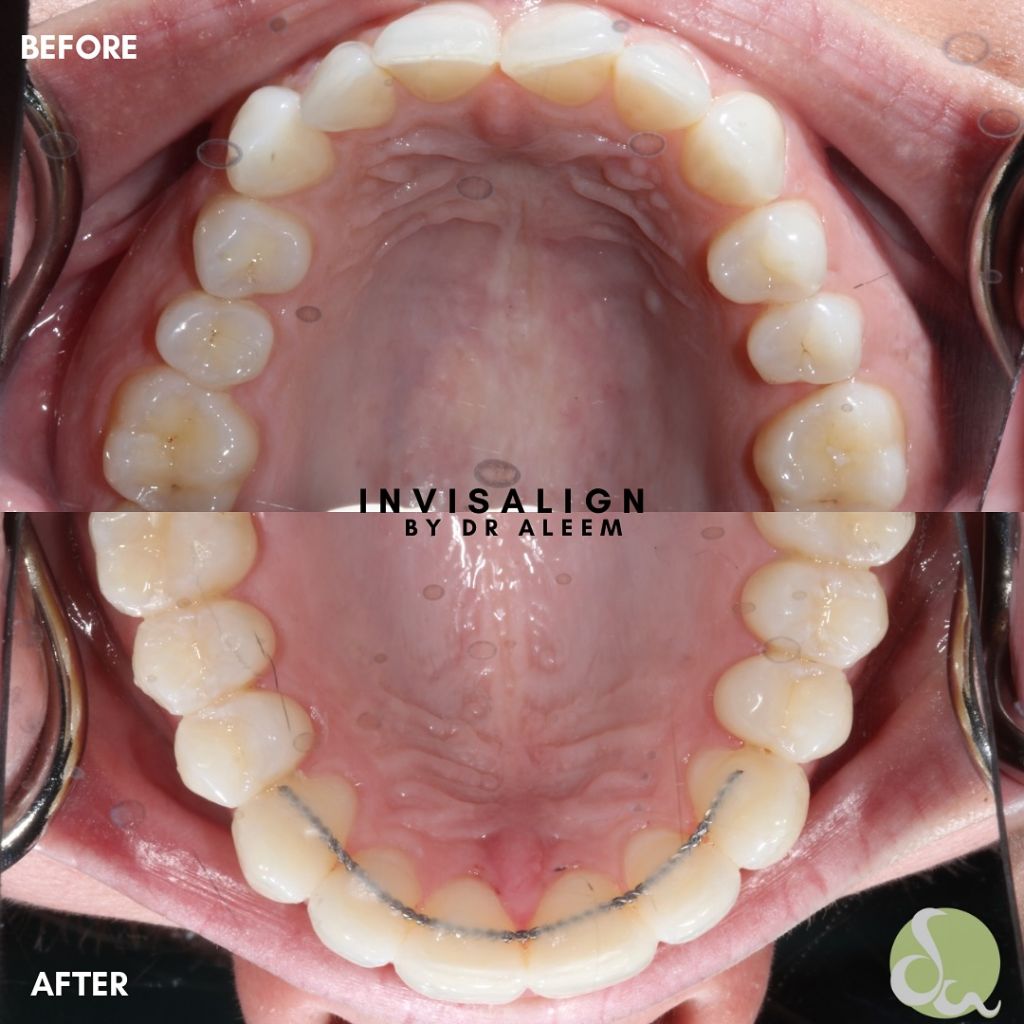
Removable aligners can be removed to eat and clean, which makes hygiene upkeep easier. They rely on you wearing them for most of the day. We offer both, and as an Invisalign Diamond Provider we fit Invisalign clear aligners regularly.
The better choice varies from one patient to the next. The cost differs between the two, and ceramic brace fees also vary from practice to practice. What decides it is your scans, your bite and how far your teeth need to move.
For real results see our teeth straightening before and after gallery
What to Remember About Ceramic Braces
Ceramic braces work as well as metal ones. What varies from person to person is how long treatment takes and how much staining there is to manage.
The key things to remember about ceramic braces:
- What they are. Fixed braces with clear or tooth-coloured brackets. Same mechanism as metal, different material.
- How treatment runs. Four stages, from scan and plan through placement, regular adjustments, and retainers afterwards.
- Who they are right for. Adults and teenagers who want discretion without losing the control of a fixed appliance, including complex cases.
- The real trade-off. Staining of the ties, the glue and the brackets. The ties are renewed at every adjustment, and rinsing after coffee and tea helps with the rest.
- What to do next. A consultation with scans is the only way to know your timeline and which appliance suits you.
For a guide to costs of the treatment read our braces cost guide.
Frequently Asked Questions
Ceramic braces work as well as metal ones for adults and teenagers alike, though they need more care with hard food and staining, and treatment time depends on how far the teeth must move.
Do ceramic braces work as well as metal braces?
Yes. The mechanism is identical, and bracket material does not change how the wire moves teeth. Ceramic is more brittle, so it needs more careful handling, but it moves teeth just as well.
How long does treatment with ceramic braces take?
It depends almost entirely on how far the teeth must move, and whether the bite needs correcting as well as the alignment. A simple cosmetic case is measured in months, a comprehensive one in years.
What can’t you eat with ceramic braces?
Avoid anything hard or sticky, and anything you would tear rather than bite. Cut up apples and crusty bread, skip toffee and boiled sweets, and be more careful with hard foods than you would with metal brackets, because ceramic can chip.
Can stained ceramic braces be cleaned?
The elastic ties can, because they are replaced at every adjustment, which clears their stain. The brackets and the adhesive stay on for the whole treatment, so rinsing with water after coffee or tea matters more for them.
Do ceramic braces break more easily than metal ones?
Ceramic is more brittle than steel, so a bracket can chip under a hard bite where metal would bend. Rebonding a bracket takes a short appointment, and it does not undo the movement already achieved.
Are ceramic braces suitable for adults?
Yes, and they are discreet enough for professional life. The treatment is the same as a teenager’s: the plan follows your teeth, not your age.
Are ceramic braces more uncomfortable than metal braces?
They are usually no more uncomfortable than any fixed appliance. Expect an ache for the first few days and briefly after each adjustment, handled with ordinary painkillers. Orthodontic wax deals with any edge that rubs.
Can a ceramic brace be fitted to the top teeth only?
It sometimes can. A ceramic brace on the upper teeth alone can work where only those teeth need moving and the bite does not need changing. It is a clinical decision, because moving one arch changes how the two meet.
Book With a Ceramic Braces Dentist at Dental Artistry
Only an examination can tell you how long your treatment would take. At our North London practice, our Specialist Orthodontist will take X-rays and a digital scan, then explain how far your teeth need to move and whether ceramic braces are right for your case. 0% finance is available over 6, 10 or 12 months on treatment plans over £2,000. Book an appointment today.
Information Sources
Treatment and brace types (British Orthodontic Society)
Ceramic brackets and adhesives in staining beverages, an in vitro study (Dentistry Journal, via PMC)
Clear orthodontic ligatures assessed by orthodontists and patients, a clinical study (Dental Press Journal of Orthodontics, via PMC)