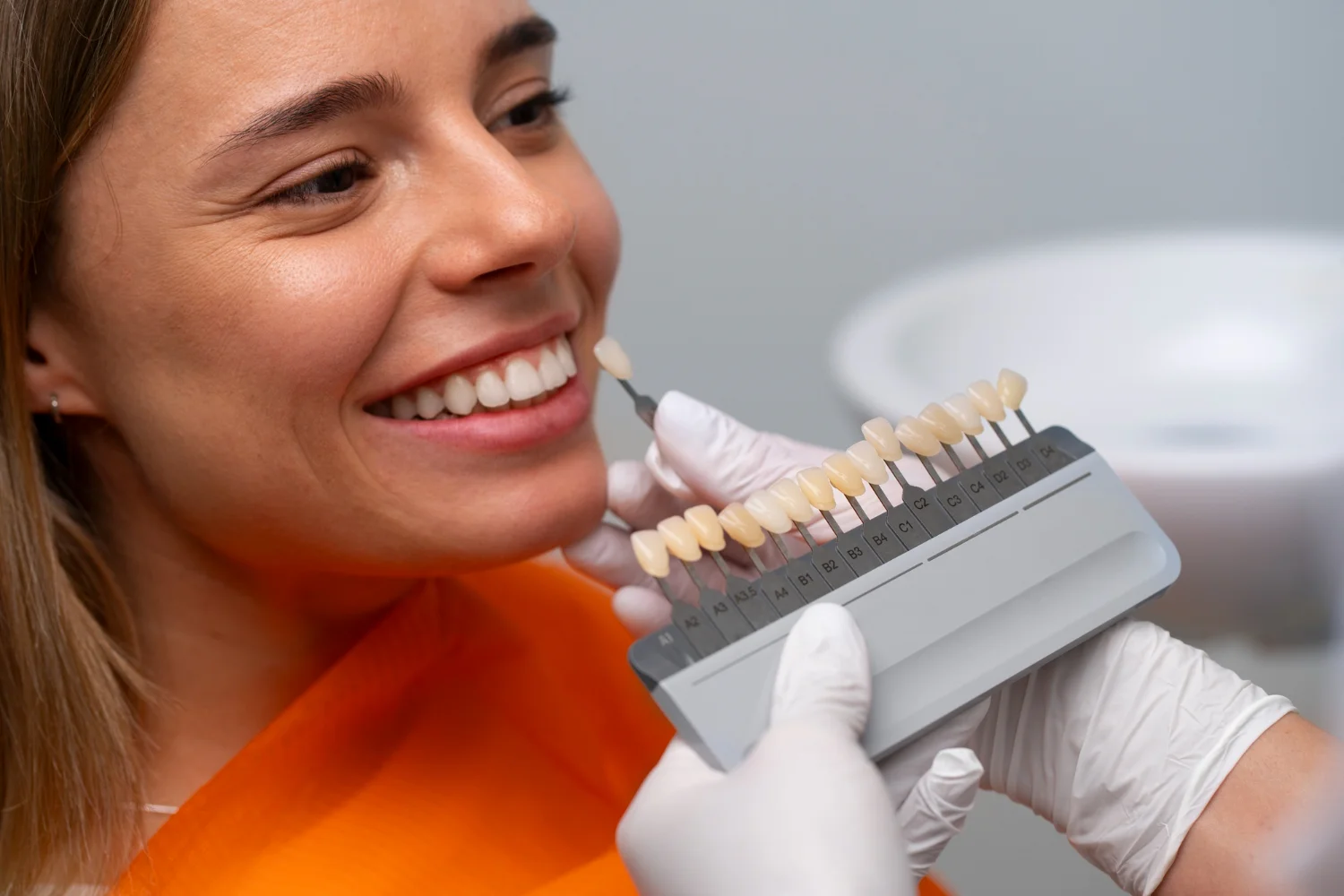
The two main types of dental veneers in the UK are composite vs porcelain veneers, and the choice between them shapes both the upfront cost and how long the result lasts.
Porcelain veneers look more natural, resist stains better, and last twice as long on average. Composite veneers cost less upfront, can be completed in a single appointment, and are reversible. Neither is universally better. The right choice depends on your budget, timeline, the condition of your teeth, and how you want to maintain the result long-term.
This guide walks through the material differences, cost and lifespan comparison, the specific pros and cons of each, and a decision framework for which veneer type tends to suit which patient.
Composite or Porcelain Veneers: The Short Answer
If you want the fastest version of the recommendation before the full breakdown, the table below maps common priorities to the better veneer material for that goal. This is an oversimplification. Real decisions depend on tooth condition, budget tier, and long-term plans, but the patterns hold for most patients starting their research.
| Priority | Better choice |
|---|---|
| Lowest upfront cost | Composite |
| Longest lifespan | Porcelain |
| Fastest treatment | Composite (one appointment) |
| Most natural appearance | Porcelain |
| Reversibility | Composite (minimal tooth prep) |
| Stain resistance | Porcelain |
| Easy repair if damaged | Composite (chairside) |
| Long-term cost efficiency | Porcelain |
For most patients who plan to keep their veneers long-term and prioritise appearance, porcelain is the better investment. For patients on a tighter budget, unsure about commitment, or wanting a trial before a permanent solution, composite is the better starting point.
What Are the Material Differences?
Porcelain veneers are thin ceramic shells made in a dental laboratory to exact specifications. The porcelain is layered, fired, and finished to match the natural translucency of tooth enamel. Modern materials include e.max (lithium disilicate) and feldspathic porcelain, both highly durable and stain-resistant. The veneer is then bonded to the prepared tooth using a specialist cement.
Composite veneers are made from a tooth-coloured resin that is built up directly on the tooth in layers, shaped by hand, and cured with a light. The composite material is the same family used for dental fillings. No laboratory work is needed, so the entire veneer is completed chairside in a single appointment.
The material difference drives every other comparison. Porcelain behaves like ceramic: harder, more brittle if struck badly, more stable long-term. Composite behaves like a dense plastic: softer, easier to adjust, less durable over decades.
Composite vs Porcelain Veneers: Cost & Lifespan Compared
The numbers matter most at the start of the research process, before brand names or clinic reputation dominate the decision. The table below covers the three areas patients ask about most often (cost per tooth, typical lifespan, and the practical differences in appointment structure), plus the less-obvious factors like annualised cost over the treatment’s full life and how each material handles repair.
| Factor | Composite Veneers | Porcelain Veneers |
|---|---|---|
| Cost per tooth (UK private) | £250-£400 | £600-£1,200 |
| Full set (10 front teeth) | £2,500-£4,000 | £6,000-£12,000 |
| Typical lifespan | 5-7 years | 10-15 years |
| Best-case lifespan | 8-10 years | 20+ years |
| Appointments | 1 (single visit) | 2-3 over 2-3 weeks |
| Tooth preparation | Minimal or none | Some enamel removal usually needed |
| Reversible | Often yes | Usually no |
| Stain resistance | Moderate | Excellent |
| Chip resistance | Moderate | High |
| Repair options | Chairside quick fix | Usually full replacement |
| Annualised cost (per tooth) | £40-£70 | £50-£100 |
| Best for | Minor shape fixes, reversibility, budget | Long-term smile makeover, stain-prone patients |
At Dental Artistry, composite bonding starts from £350 per tooth and porcelain veneers from £1,200 per tooth. Our composite bonding cost guide walks through composite pricing in detail.
What Are the Advantages of Porcelain Veneers?
Longevity. 10-15 years is the industry-standard figure, with well-maintained cases reaching 20+ years. Fewer replacement cycles over a lifetime.
Superior appearance. Porcelain’s light-reflecting properties mimic natural enamel translucency. Well-made porcelain veneers are extremely hard to detect as veneers in normal social situations.
Stain resistance. Porcelain does not absorb pigments from coffee, tea, wine, or smoking. The natural teeth around the veneers can stain, but the veneers themselves stay stable.
Structural strength. Modern porcelain handles normal biting forces well, including front-tooth wear. Less prone to edge chipping than composite.
Better for heavy cosmetic changes. When the veneer is substantially changing tooth colour, shape, or size, porcelain’s thickness and opacity handle the change more naturally than composite.
What Are the Disadvantages of Porcelain Veneers?
Higher upfront cost. Two to three times the per-tooth cost of composite. A full smile makeover ranges £6,000-£15,000 depending on tier.
Irreversible preparation. Most porcelain veneer cases require removal of a thin layer of enamel to make room for the veneer thickness and ensure a good bond. This cannot be undone.
Longer treatment time. Two or three appointments over 2-3 weeks, compared to one appointment for composite.
Laboratory dependency. The quality of the final veneer depends on both the dentist and the dental lab. Premium labs produce superior results; budget labs can produce disappointing outcomes even when the dentist’s work is excellent.
Harder to repair. Small chips usually require replacing the whole veneer rather than a chairside touch-up.
What Are the Advantages of Composite Veneers?
Much lower cost. A composite smile makeover costs half to one-third of porcelain. Makes cosmetic veneers accessible to patients who could not afford porcelain.
Single-visit completion. Walk in with natural teeth, walk out with veneers the same day. No temporary veneers, no waiting for lab work.
Minimal or no preparation. Most composite cases require little or no removal of enamel. The veneer is added TO the tooth rather than fitted into a prepared surface. Largely reversible.
Easy to adjust and repair. Small chips, edge wear, or shade adjustments can be handled chairside in a short appointment. The material flows and bonds to existing composite readily.
Reversibility. If you decide composite is not for you or want to upgrade to porcelain later, the composite can be removed without damage to the underlying tooth in most cases.
Good trial option. Patients unsure about the aesthetic commitment of permanent veneer work often use composite to “try” the look before committing to porcelain.
What Are the Disadvantages of Composite Veneers?
Shorter lifespan. 5-7 years average means 2-3 replacement cycles over a 20-year horizon vs 1-2 for porcelain. The upfront saving often narrows or disappears over the full lifespan.
More staining. Composite absorbs pigments from coffee, tea, wine, and tobacco. Regular professional polishing slows this but does not eliminate it.
Less lifelike at close inspection. Composite can look excellent, but in side-by-side comparison porcelain typically looks more natural, particularly at the incisal edges and under different lighting.
Edge chipping more common. The softer material wears or chips at the biting edges more readily than porcelain.
Skill-dependent. A great composite artist produces beautiful work. A less experienced dentist produces noticeably worse results with composite than with porcelain because composite relies entirely on the dentist’s sculpting skill.
Which Veneer Is Better for Which Patient?
No two patients arrive with the same priorities, and the “better” material depends entirely on which trade-off you can live with. The decision framework below maps common patient profiles to the better-fit material, with the reasoning that drives each recommendation. Find the profile closest to your situation and use it as a starting point for the consultation conversation.
Budget-conscious first-timer: Composite. Lower commitment, faster, reversible. Gives a clear sense of whether veneer treatment suits your mouth and lifestyle before scaling to porcelain.
Wedding or major event in a few weeks: Composite. One-appointment completion means immediate result with no laboratory delay.
Heavy coffee, tea, or wine drinker who won’t cut back: Porcelain. Stain resistance matters more than upfront saving for this lifestyle.
Long-term smile makeover plan: Porcelain. Over 20-30 years, porcelain’s longevity produces better total value and fewer disruption cycles.
Mild cosmetic issues (small gaps, minor shape fixes): Composite. The case does not need the thickness of porcelain, and composite’s reversibility protects the natural teeth.
Significant cosmetic transformation (major shape or colour change): Porcelain. The veneer thickness needed for major changes handles better in porcelain.
Heavy grinder or clencher (bruxism): Either, but with a night guard. Without a night guard, both materials fail early, though porcelain tends to crack while composite wears.
Want to preserve natural tooth structure: Composite or no-prep porcelain. Both minimise enamel removal compared to traditional porcelain preparation.
Specific patient concern: repair worry: Composite. Easier to fix chairside if damaged.
Specific patient concern: replacement worry: Porcelain. Longer gap between replacement cycles.
Can You Combine Composite & Porcelain?
Yes, and this is a legitimate strategy for specific clinical situations, not a compromise. Mixing materials lets you match visibility tiers to material strengths: premium porcelain where the camera looks, composite where the material demands are lower. The combined approach also lets patients stagger their investment over time without redoing work. Common combinations include the following.
Porcelain front 6 + composite on canines. Highest visibility teeth get premium porcelain; less visible teeth get composite to control cost.
Composite first, upgrade to porcelain later. Use composite for 5-7 years to test the aesthetic and commit to porcelain when confident.
Porcelain for shape/size change + composite for minor edge repair. Composite used as a maintenance tool alongside porcelain veneers.
A consultation plans which teeth need which material based on visibility, wear pattern, and budget. The combined approach is particularly common in smile makeovers where the front six teeth do the heavy aesthetic lifting and the canines and premolars play a supporting role.
Frequently Asked Questions – Composite vs Porcelain Veneers
Common questions from patients weighing composite against porcelain, covering the upgrade path between them, relative appearance, tooth preservation, replacement frequency, and protection for bruxism cases.
Are porcelain veneers really worth twice the cost of composite?
Over a 20-year horizon, the total cost of 2-3 composite replacement cycles often matches or exceeds the cost of a single porcelain set. Add the appointment time, the temporary discomfort of each replacement, and the gradual aesthetic drift of older composite, and porcelain’s long-term value becomes clearer. For patients who plan to keep their veneers long-term, porcelain usually wins.
Can I switch from composite to porcelain later?
Yes, and this is a common upgrade path. The composite can be removed, the underlying tooth is usually unchanged (minimal prep was done), and porcelain is fitted in its place. The upgrade counts as a new porcelain case, not a discount.
Which looks more natural?
Porcelain. The translucent light-reflecting properties of dental porcelain mimic natural enamel in ways that composite resin cannot fully replicate, especially at the incisal (biting) edges. Composite can look excellent but rarely matches porcelain side-by-side.
Does composite damage teeth less than porcelain?
Yes, in most cases. Composite requires minimal or no enamel removal, while traditional porcelain veneers usually require some enamel to be trimmed. No-prep porcelain veneers exist (very thin shells bonded to unprepared tooth surfaces) but are only suitable for specific cases.
How often do composite veneers need replacing?
On average every 5-7 years. Lifespan varies with material quality, oral hygiene, grinding habits, and staining exposure. Regular polishing appointments extend it significantly.
Can I have composite veneers if I grind my teeth?
With a night guard yes. Without a night guard, composite wears through or chips at the biting edges within 2-3 years in heavy grinders. Porcelain fares slightly better but is not immune to grinding damage. Both materials need night-guard protection for bruxism patients.
Porcelain & Composite Veneers at Dental Artistry, North London
Dental Artistry offers both composite bonding and porcelain veneers with an honest consultation that maps your specific priorities to the better material for your case. Our cosmetic team has a particular strength in composite bonding artistry and porcelain smile makeovers, and we are transparent when one approach would serve you better than the other.
For real patient results across both materials, our porcelain veneers before & after gallery shows cases spanning different starting conditions, budgets, and cosmetic goals.
Book your consultation to discuss which veneer type fits your case.
Composite vs Porcelain Veneers: What to Know Before Booking
Composite and porcelain are different answers to the same cosmetic question. Each is the right answer for a specific type of patient, and the wrong answer for another. Composite wins on upfront cost, speed, and reversibility. Porcelain wins on longevity, natural appearance, and long-term value.
A thorough consultation maps your budget, timeline, tooth condition, and lifestyle to the better-fit material. For many patients, a combination of both materials across different teeth produces the most practical result at the most manageable cost. The decision framework above should point toward a starting recommendation, but the consultation refines that recommendation into a specific plan for your teeth.
The essential points every patient should remember:
- Porcelain costs more upfront but often wins over 20 years. Two to three composite replacement cycles typically match or exceed a single porcelain set’s total cost.
- Composite is the lower-risk first step. Reversible prep, same-day result, and a clear upgrade path to porcelain later if desired.
- Appearance difference is real but subtle. Porcelain looks more natural up close, especially at the incisal edges, but composite is excellent even if not identical.
- Material choice scales with ambition. Mild fixes suit composite; major smile transformations suit porcelain’s thickness and stain resistance.
- Mixing materials is legitimate. Porcelain on the most visible teeth, composite elsewhere, keeps cost manageable without compromising the visible result.
- Bruxism patients need a night guard either way. Without protection both materials fail early. With protection both perform to their typical lifespan.
The right next step is a consultation that includes a bite assessment, a shade analysis, and a realistic conversation about maintenance expectations. For most patients the choice is not “which is better” but “which trade-off suits my life for the next 10 years”. A good cosmetic team helps you land on that answer before a single tooth is prepared.
Information Sources
Porcelain Laminate Veneer Survival Rates (PMC Systematic Review)
Resin Composite Laminate Veneer Survival (PubMed, 2023 Meta-Analysis)
Cosmetic Treatment Guide (Oral Health Foundation)